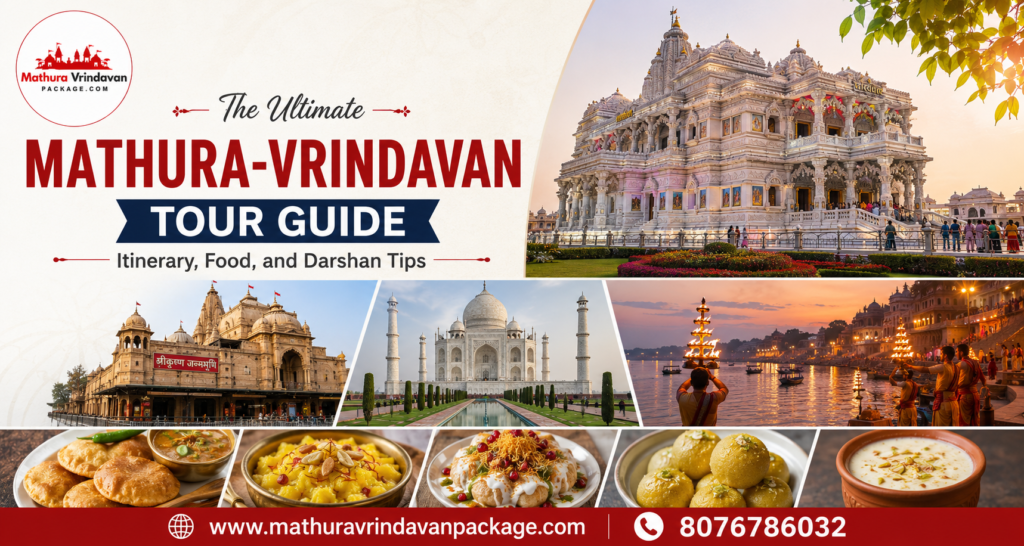

Mathura and Vrindavan are not only the places to visit for the tourists. They are the spiritual hub of India and where Lord Krishna was born and played. These holy cities attract millions of pilgrims, families and visitors from overseas each year to indulge in their lively culture, age-old temples, spiritual ambience and traditions that have been passed down through the generations.
If this is your first pilgrimage or you are returning to Braj Bhoomi, this Mathura Vrindavan Travel Guide 2026 is all you need. It lists the best temples and the latest temple timings along with local travel tips, hidden gems and useful information to make your trip smooth.
If you want to have a spiritual experience you will never forget, this guide will help you to plan your trip with confidence.
Why Visit Mathura & Vrindavan in 2026?
Mathura and Vrindavan are growing cities, with improved roads, tourist facilities and infrastructure, but still retain their deep spiritual heritage. The journey from Delhi has become much faster with the Yamuna Expressway and there are a range of accommodation options to fit any budget from budget-friendly guesthouses to luxurious hotels.
And going in 2026, tourists will get to enjoy a place where modern comforts and old world charm co-exist. Whether it is the peaceful evening aarti on the banks of Yamuna River, the ancient temples or the Janmashtami, every moment in Braj is extremely meaningful.
How to Reach Mathura & Vrindavan
The holy twin cities of Mathura and Vrindavan enjoy good connectivity given their location on one of India’s most heavily connected transit corridors (Delhi-Agra). You can take the rail, road or air depending on your budget, starting point and how fast you want to go.
- By Train (The Cheapest and Most Popular Way)
Mathura Junction (MTJ) is a major railway junction of North India. Mumbai, Delhi, Chennai, Jaipur and Hyderabad are the main cities from where long-distance trains stop here.
- From Delhi:Trains run from New Delhi Railway Station (NDLS), Hazrat Nizamuddin (NZM) and Delhi Hazrat Nizamuddin almost at hourly intervals. Superfast links such as the Gatimaan Express and the Taj Express are available, and budget passenger trains are also an option. It is expected to take between 1.5 and 2 hours.
- From Agra: Mathura is just 45–60 minutes away by train from Agra Cantt (AGC).
Pro-Tip for Vrindavan: There is a small local station in Vrindavan but no long-distance trains call here. You have to get off at Mathura Junction. From Mathura Jn there are two ways of getting to Vrindavan (~12 km): take an auto-rickshaw (25 minutes) directly or, if the timings suit, catch the local Mathura-Vrindavan rail-bus passenger link.
2. By Road (The Most Flexible Route)
Getting there is easy via road, particularly if you’re coming from the National Capital Region (NCR).
By bus: Uttar Pradesh State Road Transport Corporation (UPSRTC) runs regular Volvo, AC and non-AC buses from Sarai Kale Khan and Anand Vihar ISBT in Delhi. Buses either drop off passengers at Mathura New Bus Stand or the highway flyover near Vrindavan.
Yamuna Expressway provides easy multi-lane road transport which can be reached from Delhi or Noida, by taxi or by car. It is usually a 2½ to 3 hours journey from Delhi. As soon as you get off the Expressway, you will be on the link roads to Mathura-Vrindavan.
3. By Air (Nearest Airports)
While the twin cities do not have their own commercial airport, multiple entry points serve the region:
Noida International Airport, Jewar (Closest Alternative): 90–100 km away via the Yamuna Expressway. This airport is just 1.5 hours away from Mathura or Vrindavan by a direct taxi and you can skip the traffic of Delhi city.
Indira Gandhi International Airport, New Delhi (DEL), about 165km away. On arrival you can take the Delhi Metro or hire a prepaid outstation taxi to board a connecting train at New Delhi Railway Station.
The nearest airport is Agra Airport (Kheria) which is about 60 kms away but has limited domestic flights as compared to Delhi.
Best Time to Visit Mathura & Vrindavan
Although Mathura and Vrindavan welcome visitors throughout the year, the best season depends on your travel preferences.
1.Winter (October to March) — Best Weather & Peak Season
- Temperature: 8°C to 28°C
- The Atmosphere: Festive lights, busy streets and pleasant evening aartis on the Yamuna River.
- The month of Kartik (October–November) is the most sacred month of the year in Braj. At Keshi Ghat, thousands of people gather for the evening Deep-Daan, the lighting of floating lamps.
- Braj Holi (February/March) is a bucket-list world-famous celebration with grand temple celebrations, flowers and colours.
Traveler Note: This is the height of the season. Weekends are full of tourists from Delhi NCR and they are very crowded. If you want a peaceful winter experience, try to go mid-January to early February on a weekday.
2. Monsoon (July to September) — Deeply Devotional
Twin cities have a softer, wildly green and deeply spiritual side, if you’re not averse to the occasional drenching and muggy interlude during the rainy season.
- Temperature: 25°C – 35°C
- The atmosphere is suffused with the smell of moist earth, the Yamuna River is in full spate and the ancient temple walls look pristine after the recent rain.
- Janmashtami (August) is observed as the birthday of Lord Krishna. In Mathura (his birthplace) and Vrindavan thousands of chanting devotees take part in deeply moving midnight observances.
- Jhulan Yatra : The monsoon festival when the deities are taken out in procession on silver and gold swings.
- Traveler Tip: Some minor waterlogging can be expected on streets in case of heavy rains. The biggest crowd surges happen during Janmashtami, when hotel reservations are made months in advance.
3. Summer (April to June) — The Quiet/Budget Season
The extreme heat and dry conditions of Uttar Pradesh summers make it difficult to sightsee outside during the day.
- Temperature range 30 degC – 45 degC
- Atmosphere: A quiet, unhurried, inexpensive atmosphere.
- Traveler Note: If you are traveling in this window, plan your itinerary only in the early mornings (06:00 AM to 09:30 AM) and late evenings (05:00 PM to 08:30 PM). What’s the biggest benefit? Good discounts on luxury hotels in the off-season. Temple courts are quiet, darshan lines are non-existent.
Best Temples to Visit in Mathura & Vrindavan
- Shri Krishna Janmasthan Temple
This huge complex is devoted to the historical birthplace of Lord Krishna. Visitors can descend to the underground stone vault (Garbha Griha), the prison cell where Krishna was born.
Key Feature: On the site there is a big temple structure, an artificial cave representing Krishna’s life activities and heavily guarded entry security corridors.
You are required to leave all digital items such as mobile phones, smart watches and keys in the free lockers outside before entering the premises.
- Banke Bihari Mandir
This temple is a throbbing centre at the spiritual design of Vrindavan. The priests keep closing the curtain and open it every few seconds to avoid the public staring into the eyes of the deity of Banke Bihari continuously.
Key Characteristic: No temple bells in the interior, but rhythmic chanting and constant clapping in the air.
Just a reminder to hold onto your glasses as the local monkeys have a reputation for stealing them. The paths around are very narrow and crowded.
- Prem Mandir Temple
The entire structure of Prem Mandir is made of Italian white marble and is adorned with beautiful carvings of the life of Lord Krishna. Thousands of visitors flock to the musical fountain and light show held in the evening every day.
Best Time: After the sun sets.
- ISKCON Krishna Balaram Temple
A pristine white marble courtyard, a bookstore, a bakery and a popular dining setup are found at this complex, an international hub for Krishna consciousness.
It is the high energy kirtans that are the main highlight attracting both local and international visitors in a celebration of music and dance.
Important Note: The Mangala Aarti which starts at 05:00 AM is a spiritual start to the day’s schedule.
- Dwarakadish Temple
This temple is historic and is located near the banks of the Yamuna River. It is a testimony to the great Rajasthani artwork and architecture. It is an ode to Krishna in his royal avatar as King of Dwarka.
Feature highlight: The central open-air courtyard is decorated with lively ceiling murals of pastimes and festivals.
Important Note: It is conveniently located in the bustling lanes of Vishram Bazar, and complements a morning boat ride at Vishram Ghat perfectly.
- Radha Raman Temple:
This historic temple houses a self manifested deity of Lord Krishna and makes the darshan experience more traditional and peaceful.
- Nidhivan Temple
One of the most mysterious places of Braj is Nidhivan, where Lord Krishna is said to perform Raas Leela every night. No guests are allowed to stay inside after dark.
- Temple of Radha Vallabh
This temple is famous among the followers of Krishna for its peaceful environment and devotional practices.
Mathura Vrindavan Temple Timings (2026)
| Temple | Morning | Evening |
|---|---|---|
| Shri Krishna Janmabhoomi | 5:00 AM – 12:00 PM | 4:00 PM – 9:30 PM |
| Banke Bihari Temple* | 7:45 AM – 12:00 PM | 5:30 PM – 9:30 PM |
| Prem Mandir | 8:30 AM – 12:00 PM | 4:30 PM – 8:30 PM |
| ISKCON Temple | 4:30 AM – 1:00 PM | 4:00 PM – 8:30 PM |
| Dwarkadhish Temple | 6:30 AM – 10:30 AM | 4:00 PM – 7:00 PM |
| Radha Raman Temple | 8:00 AM – 12:30 PM | 6:00 PM – 8:30 PM |
Note: Temple timings may change during festivals, Ekadashi, Janmashtami, Holi, and other religious occasions. Always verify the latest timings before your visit.
2 Days Mathura Vrindavan Package Itinerary
Day 1: Gokul, Mathura, and Vrindava
Start your day at Gokul by visiting the holy places where Lord Krishna spent his childhood, including Raman Reti and Chinta Haran Ghat. Don’t miss the town’s afternoon buzz – arrive in Mathura by noon and see the Shri Krishna Janmasthan (birthplace temple) and the historic Dwarkadhish Temple. In the evening, watch the amazing illuminated light and musical fountain show at Prem Mandir and attend the evening darshan at the busy Banke Bihari Temple to end your day in Vrindavan.
Day 2: Goverdhan, Barsana, and Nandgaon
On the second day, you will explore the wider Braj region in the morning. Start with Mansi Ganga, Haridev Temple, and the holy Goverdhan Hill in Goverdhan. Then you will visit Barsana, the historic birthplace of Radha Rani. Climb the steps to the beautiful Radha Rani Temple, which is located on Bhanugarh Hill. Finally, spend the afternoon in Nandgaon. Here you can visit the hilltop Nand Bhawan temple, the ancient home of Lord Krishna’s foster parents. The temple offers a panoramic view of the surrounding countryside and you will be on your way back soon.
What to Eat in Mathura & Vrindavan
Experience the authentic flavors of Braj cuisine on your visit to Mathura and Vrindavan. The area is famous for traditional vegetarian food, fresh dairy products and delicious sweets that reflect its rich cultural and spiritual heritage. Whether it’s the bustling roads of Mathura or the temple lanes of Vrindavan, you will find many local joints serving freshly cooked delicacies.
- Mathura Peda
Mathura Peda is the signature sweet of the city and one of the most popular souvenirs for the visitors. This is a delicious sweet made from khoya (slowly cooked milk), sugar and cardamom. It is often served as prasad in temples. - Bedai Aur Aloo Sabji
Bedai is a traditional Braj breakfast. It is a crisp deep fried bread served with a spicy potato curry. It is best eaten in the early morning at local food stalls in Mathura. - Sabzi kachori
Kachoris are stuffed with spiced lentils and served with a tangy potato curry, and are popular with both locals and tourists. Serve with a hot jalebi and you have a complete breakfast. - Lassi (lassi)
The thick lassi of Mathura is made from fresh curd and topped with a layer of creamy malai and is cool and refreshing. It’s the perfect thing to sip after a day of temple sightseeing. - Jalebi
Mathura and Vrindavan are full of hot jalebis, freshly fried and soaked in sugar syrup, especially in the breakfast and evening hours. - Rabri
Rabri is a rich dessert prepared by slowly reducing milk to a thick and creamy consistency and flavoured with saffron, cardamom and dry fruits. - Mishri Makhan
Makhan Mishri is Lord Krishna’s favorite offering of a simple yet delicious combination of fresh white butter and sugar crystals. It is given as prasad in many temples. - Sattvik Thali
Vrindavan has many restaurants and ashrams that offer healthy sattvik meals without the use of onion or garlic. These thalis usually comprise of roti, seasonal vegetables, dal, rice, curd and traditional sweets.
Food Tips for Travelers:
- Look out for clean and hygienic restaurants or popular local eateries.
- Wake up early to have your breakfast and enjoy the fresh Bedai, Kachori and Jalebi.
- Keep bottled water available, especially in summer.
- For quality and freshness, try the local sweets from a good sweet shop.
- Respect the temple customs and avoid non-vegetarian food and alcohol during your visit.
Local Secrets and Hidden Gems of Braj
Radha Raman Temple Ancient Peace
Another of the Seven Temples of Vrindavan Goswamis, the Radha Raman Temple is a historic site for those seeking peaceful devotion. While the crowds gather at Banke Bihari, those who prefer a more relaxed atmosphere walk to the temple. Radha Raman deity appeared on its own from a sacred Shaligram Shila installed in 1542 by Gopala Bhatta Goswami. What is most important is that this temple has preserved an unbroken succession of traditional rituals for nearly five centuries. Modern electronic lights and loudspeakers do not disturb the sanctuary, and the temple kitchen continues to cook using a sacred fire that was kindled 500 years ago. Come here at 8 in the morning for the morning Shringar rituals. The atmosphere is very personal, intimate and quiet.
The Mysticism of Early Morning Nidhivan
Nidhivan is a dense enclosed forest with intertwined downward growing branches of unusual short Tulsi (holy basil) trees. Local spiritual lore informs us that the gates close each evening, all humans and animals vacate, and the forest turns into a cosmic stage for Lord Krishna’s Raas Leela with Radha Rani and the Gopis. The sensory faculties of any individual left behind to observe the play are said to fail. It’s myth-telling guides all through the evening, but the real local secret is to go at 7.00am, as soon as the gates open. Walking the stone paths in the utter silence of the morning before the tourists and vendors arrive, you can feel the powerful, natural energy of the grove.
Sunrise Crossing Keshi Ghat to Baba Devra Ghat
Most of the tourists throng the old Keshi Ghat where Krishna is said to have vanquished the horse-demon Keshi on the busy and noisy evening of the Yamuna Aarti. Reverse this timeline completely. Arrive at Keshi Ghat just as the sun rises, when the first golden rays strike the grand sandstone ancient facades that reflect off the river.Rent a rowboat. A wooden boat that is traditional. No motor. Instead of just looking at the banks, ask the boatman to ferry you across the Yamuna to the quiet eastern bank and visit the heritage site of Devra Baba Ghat.
In utter silence, broken only by the lapping of the water and the calls of the migrating birds, from this immaculate vantage point one can look upon the historic skyline of Vrindavan.
The Holy Playgrounds of Gokul, Raman Reti
Mathura was on the other side of the river, and Krishna had his protected infancy in Gokul. The crown jewel of this sector is Raman Reti, a vast sanctuary that is entirely covered in soft, fine white sand. Legend says the Lord played and rolled with his brother Balaram and cowherd friends. The local tradition in this region is not a regular temple sightseeing. The visitors need to take off their shoes, sit down and literally let the holy sand run through their hands or roll in it to show their bond with the land. The adjoining deer park and natural bird sanctuary add pristine rural calm, which contrasts beautifully with the dense urban environments of the main cities.
Practical Travel Tips For Mathura Vrindavan
- It is important to dress modestly when visiting temples.
- You’ll be doing a lot of walking so it’s a good idea to bring comfortable shoes.
- Remove your shoes before entering temples.
- If you are near the Banke Bihari Temple where monkeys are particularly abundant, keep your
- sunglasses and mobile phone secured.
- Bring a container of drinking water with you in summer.
- Use e-rickshaws for local transport in the congested lanes of Vrindavan.
- Avoid non-licensed guides who request donations or special darshan fees.
- Keep enough cash handy for parking, e-rickshaws and small purchases.
- Book your taxi and hotels in advance for Janmashtami and Holi.
Why Choose Mathura Vrindavan Package?
Planning a pilgrimage should be peaceful—not stressful. Choosing a trusted local travel company can save time, reduce hassles, and enhance your overall experience. Advantages of Mathura Vrindavan Package are as follows:
- Customized tour itineraries
- Private AC taxicabs operated by local drivers with experience.
- Budget, luxury and premium hotel choices
- Families and senior citizens travel plans
- Simple Pricing No Hidden Fees
- Customer services are available 24 hours a day, 7 days a week.
- Local Knowledge to make the most out of your visit
Whether you are heading for a day trip or a multi-day pilgrimage covering Govardhan, Barsana, Gokul and Agra, professional planning guarantees a memorable and smooth travel.
Frequently Asked Questions (FAQs)
Is two days enough for Mathura and Vrindavan?
Yes. Two days are sufficient to visit the major temples and nearby attractions. If you wish to explore Govardhan, Barsana, and Gokul at a relaxed pace, consider extending your stay to three or four days.
Which temple should I visit first?
Most devotees begin with Shri Krishna Janmabhoomi Temple in Mathura before proceeding to Vrindavan.
Can I visit Mathura and Vrindavan in one day?
Yes, but you’ll need an early start and a well-planned itinerary. A private vehicle is recommended for efficient travel.
Are mobile phones allowed inside temples?
Policies vary. Some temples have security restrictions, so check the rules before entering.
Is photography allowed?
Photography is permitted at many locations, but several temples prohibit it inside the sanctum. Always follow posted guidelines.
What is the best way to travel locally?
Private taxis are ideal for sightseeing between towns, while e-rickshaws are the most convenient option for exploring Vrindavan’s narrow lanes.
Is Mathura and Vrindavan safe for families?
Yes. The region is generally safe for families, solo travelers, and senior citizens. However, remain cautious in crowded areas and keep personal belongings secure.
Plan Your Mathura Vrindavan Trip Today
📞 +91-8076786032
💬 WhatsApp: +918076786032
We Reply in 15 Minutes
Visit : https://www.mathuravrindavanpackage.com
Packages start from ₹1,699/ per person | Rated 4.8★ / 380+ Reviews